UDL: THE ULTIMATE STYLE OF LEARNING
Think of a recent learning experience (online or otherwise) you’ve had as a student. Where did it assume an “average” learner? Briefly describe one or more ways you would redesign it using UDL principles to better support learner variability.
A few terms ago, I took a philosophy course focused on formal logic and set theory. The content itself was super fascinating, but the entire setup was designed for a mythical “average” learner. Every single week followed the exact same routine: a heavy, dense textbook reading, followed by a three-hour slide-heavy lecture, and a weekly text-only quiz on our learning management system.
This layout made a massive assumption: that every student absorbs complex, abstract rules best by reading them or listening to someone talk about them for hours. It completely ignored learner variability. If you had trouble focusing during a long lecture, struggled with reading comprehension, or needed to physically sketch out concepts like Venn diagrams to understand them, the design basically left you behind. It felt like that classic graphic of the three kids trying to watch a baseball game behind a solid wooden fence—the environment itself was the barrier.
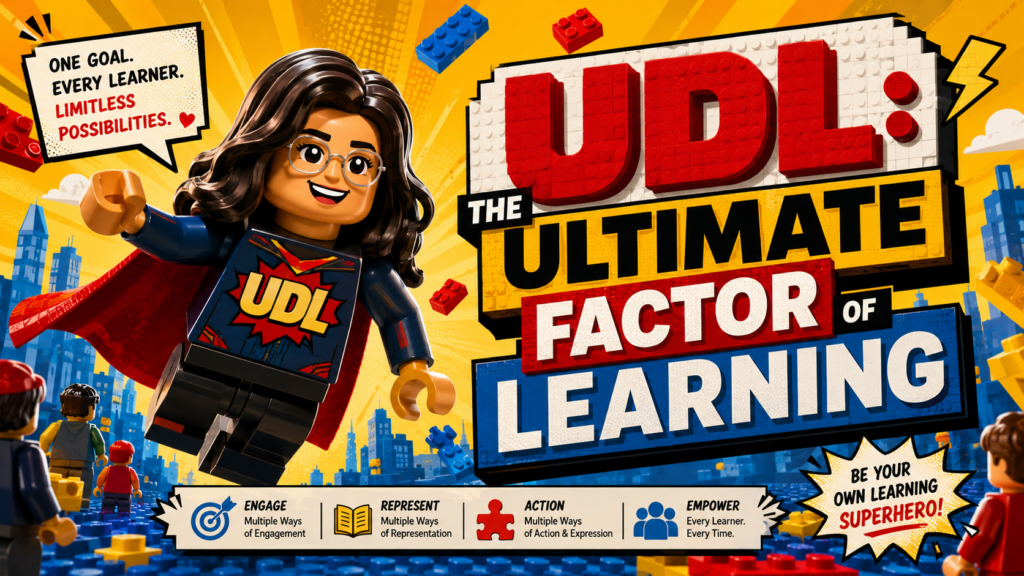
If I were to redesign this course using Universal Design for Learning (UDL) principles, my main goal would be to tear down that fence so everyone can see, rather than forcing individual students to ask for special accommodations.
First, I would fix the multiple means of representation. Instead of relying only on a standard textbook, I would offer flexible pathways to get the information. For example, using malleable digital media like WordPress or Pressbooks allows you to offer text alongside short video breakdowns, interactive logic trees, and audio options. It’s like the GPS metaphor from our course readings—letting the user choose their own route and layout based on what they need at that moment.
Second, I’d change the multiple means of action and expression. Weekly text quizzes only test how well someone reads under a time limit, not necessarily how well they understand the logic. I would let students demonstrate their knowledge in different ways—whether that’s submitting a photo of a hand-drawn Venn diagram logic flow, writing a short reflection, or completing an interactive H5P drag-and-drop scenario quiz.
What is essential for some is almost always good for all (Meyer et al., 2014). Just like how sidewalk curb cuts help people with strollers and bikes alongside wheelchair users, making a logic course more visual and interactive helps the entire class catch up, stay engaged, and actually master the material.
References
Kearney, D. B. (Ed.). (2022). Universal Design for Learning (UDL) for Inclusion, Diversity, Equity, and Accessibility (IDEA). eCampusOntario Pressbooks. https://ecampusontario.pressbooks.pub/universaldesign/
Meyer, A., Rose, D. H., & Gordon, D. (2014). Universal design for learning: Theory and practice. CAST Professional Publishing.